
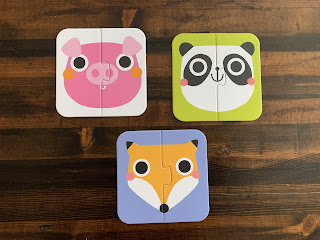
In our household, puzzles are a universal language of engagement, bridging the gap between mere play and early cognitive development. Our latest acquisition for the nursery is the On-The-Go Puzzles: Halves Faces. This set features eight charming animal portraits, each rendered in a vibrant, high-contrast style. While many "first puzzles" for infants utilize flat, abutted edges, these utilize a traditional—albeit simplified—single-notch jigsaw connection. I find this design choice far superior, as it requires the child to physically manipulate the pieces to achieve a "lock," providing a genuine sense of accomplishment and a more sophisticated introduction to spatial reasoning.
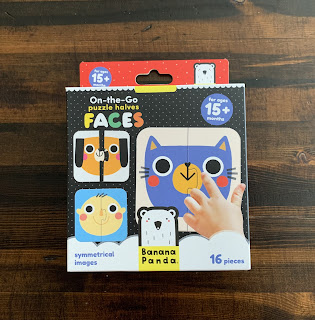
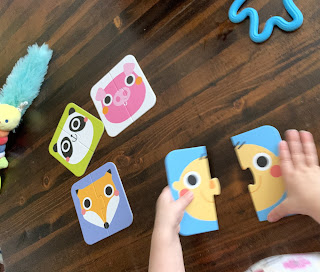
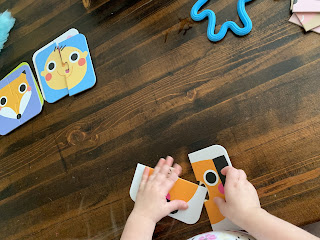
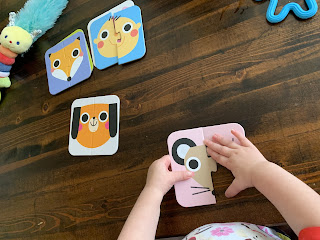

However, a child’s developmental timeline doesn't always align with the manufacturer’s suggestions. Although the box advertises these for ages fifteen months and up, my twenty-one-month-old daughter is currently in a state of "mechanical transition." She hasn't quite grasped the necessity of lifting and "nesting" the notch; instead, she attempts to slide the pieces together horizontally, leading to some adorable (yet vocal) toddler frustration. She also treats the animal halves as interchangeable, often creating some very avant-garde hybrid creatures. My oldest daughter experienced a similar learning curve at this age, so I view this less as a hurdle and more as a delightful "work in progress" for her fine motor skills.

I am a firm proponent of the "multi-purpose resource," and these puzzles are excellent candidates for pedagogical pivoting. Even if the jigsaw aspect remains elusive, we utilize the cards as high-quality flashcards for species identification, animal vocalizations, and habitat discussions. Since our youngest is currently honing her color recognition, I often task her with finding all the "verdant" pieces or identifying the primary hues on the lion’s mane. A significant safety benefit is the physical construction: the pieces feature generously rounded edges, ensuring that even a spirited grab won't result in any sharp-edged mishaps.

My only critique concerns the "on-the-go" branding. Unless your vehicle is equipped with a stable travel desk, these pieces are likely to vanish into the abyss of the car seat after the first sharp turn. However, as a "waiting room" diversion in a diaper bag, they are absolute perfection. They are compact, durable, and visually stimulating enough to provide a much-needed reprieve during an appointment.

Ultimately, the On-The-Go Puzzles: Halves Faces is a lovely addition to an early childhood morning basket. They offer a tangible, colorful way to build hand-eye coordination and vocabulary, even if the "jigsaw" epiphany takes a few extra months to arrive. I am always curating new "busy bag" items for our collection—what specific tools have you found that successfully bridge the gap between simple play and complex motor skills? Share your favorites in the comments below!

Those look like lots of fun. I'm thinking my grandbabies would love this activity!
ReplyDeleteMy son has this and loves it too!
ReplyDelete