
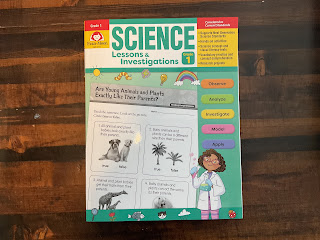
In our continued exploration of the Evan-Moor library, we recently evaluated the Science Lessons and Investigations - Grade 1 workbook. This resource offers a broad, thematic survey of the natural world, encompassing life science (plants and animals), earth science, and physical science. A particularly thoughtful inclusion is the "materials request" form at the commencement of the volume; it’s a sophisticated logistical tool that allows co-op facilitators or traditional classroom teachers to seamlessly coordinate experimental supplies with parents. To enhance the student experience, I opted to extract the perforated pages and staple them into individual thematic booklets—a method that feels much more intentional than simply handing over a loose stack of worksheets.
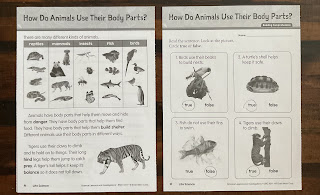
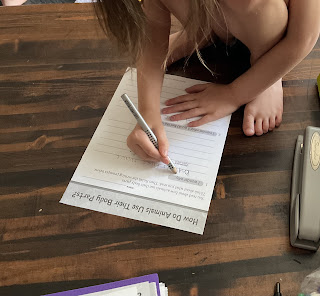


Each instructional module is anchored by a comprehensive teacher overview, providing all the necessary intellectual scaffolding before the student engagement begins. The lessons officially debut with a personalized title page, followed by a terminology primer to establish a robust scientific vocabulary. Interestingly, my daughter—at the age of six—already possessed a firm grasp of the featured concepts, which allowed us to navigate the linguistic portions with remarkable celerity. We then transitioned into the reading segments; while I facilitated the narration, the content was clear enough that she required very little clarification. These readings are followed by comprehension exercises, "I wonder why" inquiries, and—my personal favorite—integrated STEM challenges.

The "pièce de résistance" of each lesson is undoubtedly the concluding experiment or project. Upon auditing the entire curriculum, I made a somewhat surprising pedagogical discovery: while the text is marketed for the first grade, the conceptual depth feels much more aligned with a kindergarten level. Having already conquered these milestones in our previous academic year, we treated this workbook as a high-energy retrospective. To my delight, my daughter remained thoroughly enchanted by the material, specifically citing the hands-on investigations as her favorite component. It is a testament to the curriculum's design that she remains eager to "re-discover" concepts she has already mastered.

However, I must offer a candid critique regarding the visual presentation. The entire volume is rendered in black and white, which can occasionally obscure the finer details of the scientific illustrations. In a discipline where visual evidence is paramount, a vibrant, full-color layout would significantly elevate the student's engagement. Furthermore, I would hesitate to label this a "comprehensive" primary curriculum; it lacks the exhaustive rigor required for a standalone program. Instead, it shines as a magnificent supplement—perfect for those of us who prioritize a significant, "show-stopping" science project every month.

Ultimately, Science Lessons and Investigations is a delightful "value-add" for any primary science block, particularly if you are seeking structured, low-prep experiments to break up the monotony of textbook learning. We have already secured the second-grade version, and I am quite keen to see if the complexity increases as we move forward. I am curious to hear from the laboratory of your own homes—what is the "gold standard" science curriculum in your household? Do you prefer a textbook-heavy approach, or are you, like us, constantly on the hunt for the next great experiment? Let us know in the comments below!

Comments
Post a Comment