
As we approach the finale of our first-grade academic odyssey, I felt it was only fitting to offer a sophisticated retrospective on the pedagogical triumphs and occasional logistical detours we encountered. Utilizing our meticulously curated Timberdoodle curriculum as our primary compass, we navigated the year with a blend of academic rigor and spirited engagement. Looking back, I can confidently assert that while the journey required significant intentionality, the intellectual growth I witnessed in my daughter has been nothing short of spectacular. It is a profound privilege to witness the "lightbulb moments" that transform a curriculum from a box of books into a lifelong love of learning.


In our household, the English block is a comprehensive powerhouse that synthesizes reading, spelling, grammar, and composition into a singular, cohesive discipline. My primary objectives were to bolster her reading fluency and foster independent orthography—goals that, I’m thrilled to report, have been decisively conquered. I’ll admit to a moment of maternal vulnerability earlier this year; I opted for an extended schedule to ensure her literacy was "on par," only to realize she was already performing at an exemplary level. Despite my brief moment of doubt, she has surpassed every benchmark I established. When I inquired about her perspective, she noted, "I really like the games because they are fun, even though reading is quite a challenge."
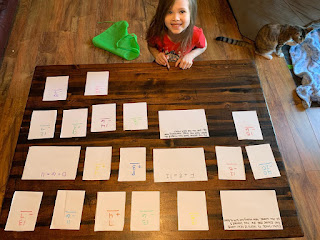

Our Mathematics journey provided a surprising turn when we encountered "solving for the unknown"—a concept I certainly don't recall tackling in the first grade during my own tenure in public school! However, my daughter has demonstrated remarkable facility with these algebraic precursors, navigating the Math-U-See textbook with complete autonomy. Her mastery of mathematical facts has reached a point where the physical manipulatives are now largely ornamental. To add a touch of "Sophisticated Comedienne" flair to our drills, I introduced a "Mystery Number" game where we compare our transcribed digits for accuracy. Her verdict? "I think math is very good, and my favorite thing is the mystery number."
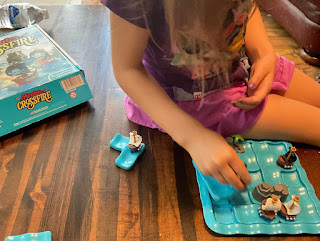

One of the more intellectually rewarding facets of our schedule is Thinking Skills, a subject that remains an outlier for some families but is a non-negotiable pillar in ours. This class offers a fascinating window into her cognitive processing and creative potential, favoring analytical games and investigative workbook pages over rote memorization. It is truly the "gymnastics of the mind," and my daughter is clearly an athlete in this arena. She eloquently summarized the experience, stating, "The class is fun because the games are really interesting and cool." It is proof that when you gamify education, the student forgets they are even being instructed.

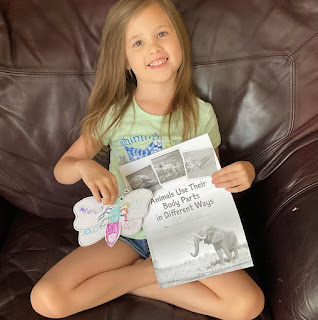
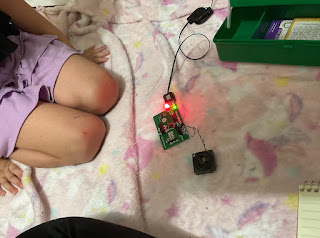

Regarding the "non-mandatory" subjects—History and Science—we embrace them with the same intensity as our core requirements. Whether we are traversing the ancient world with Story of the World or investigating the vibrant, kid-friendly diagrams in Building Blocks of Science, my daughter’s retention is nothing short of uncanny. She can recall historical narratives from the autumn term as easily as yesterday’s science experiment. She finds the past "inherently interesting" and, in true scientist fashion, declares that experiments are superior "especially when they explode." It is a reminder that even the most sophisticated scholars appreciate a well-timed chemical reaction.

Finally, our curriculum is rounded out by STEM, Art, and physical electives, which serve as the essential "breathing room" between our more rigorous evaluations. We prioritize monthly projects and weekly creative outbursts, maintaining a firm belief that not every moment of the school day must be strictly academic—some should be purely for the joy of the craft. Of all her extracurricular pursuits, gymnastics remains her undisputed favorite, particularly for the opportunity to master "the mermaid" on the bars. As we pivot toward the second grade, I am curious to hear from you: how do you handle your end-of-year retrospectives? Do you follow a structured review, or are you already dreaming of next year’s box day?

Comments
Post a Comment