
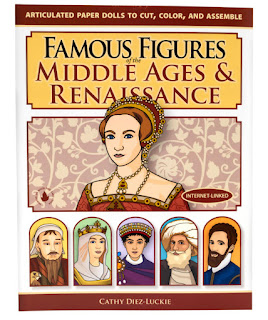
For our current historical deep-dive into the Middle Ages and the Renaissance, we have recruited a rather charming supplemental crew: Famous Figures. Having found this resource quite agreeable during our first-grade exploits, it felt only natural to invite these historical luminaries back for an encore. The book opens with a collection of succinct, informative biographical paragraphs that delineate the achievements and legacies of each individual. While I must confess to bypassing these summaries last year, they offer a sophisticated academic foundation for those days when one wishes to emphasize the "why" behind the "who."
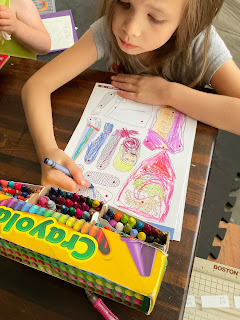


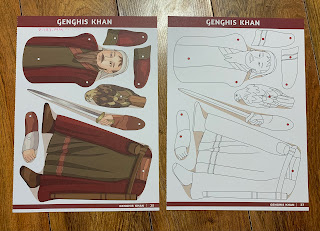

The pedagogical structure of the book provides two distinct versions for each historical figure: a pre-colored "teacher" rendition and a black-and-white "student" silhouette intended for coloring. Initially, my daughter approached the coloring phase with genuine enthusiasm; however, by the midpoint of the curriculum, her artistic stamina began to wane. Consequently, I pivoted to a more pragmatic strategy, utilizing the pre-colored versions so she could transition straight to the "imaginative play" phase. I do, occasionally, mandate the coloring of a figure as a tactical exercise in patience, sometimes joining her to demonstrate that meticulous craftsmanship is an endeavor worth savoring, even when it requires a significant temporal investment.

One minor logistical caveat: the book does not include the essential brass fasteners required for assembly. Fortunately, a swift trip to Walmart yielded a surplus of these pins for a mere dollar—a small price to pay for the structural integrity of a medieval monarch. The instructional workflow is remarkably seamless, particularly if you synchronize the figures with the chronological progression of a text like Story of the World. Once a figure emerges in our history reading, we simply reference their biographical paragraph, perform the necessary extractions, and assemble our new historical companion.

The finished products are impressively substantial in size and feature an incredibly thoughtful detail: each figure’s name is inscribed on the reverse side. This is a subtle yet vital inclusion, as identifying a dozen different men in tunics without a cheat sheet would be a logistical nightmare for any instructor. The attention to period-accurate attire is equally commendable, often featuring intricate accessories that highlight specific historical trivia. For example, William Shakespeare is equipped with a quill and parchment, while Genghis Khan is accompanied by a hawk—a nod to his legendary use of raptors for tactical scouting. It is precisely these minute details that transform a paper doll into a legitimate educational tool.

While I wouldn't categorize this as an absolute necessity for every homeschool library, it has proven instrumental in breathing life into the static pages of our history textbook. My daughter takes immense pleasure in utilizing these figures to dramatize the narratives we read, effectively turning our living room into a theater of historical reenactment. Despite our tendency to favor the pre-colored pages to preserve our collective sanity, I fully intend to retain this resource for our third-grade curriculum. It arrived as part of our 2nd Grade Timberdoodle kit and has since become a staple of our historical studies. I am curious—how do you facilitate historical immersion in your household?

Comments
Post a Comment